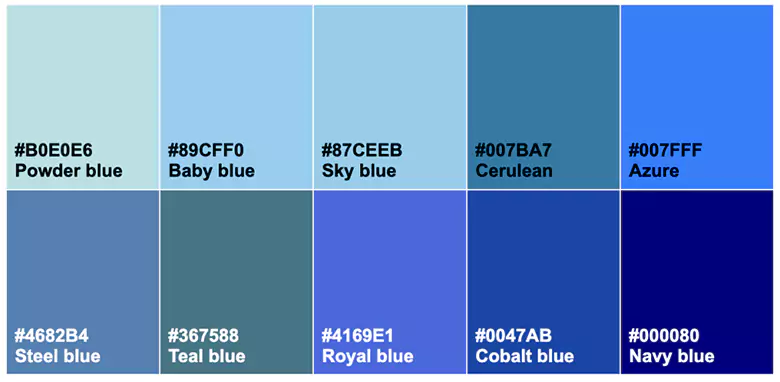
Light spectrum wavelengths measuring between 450 and 495 nanometers register in the human visual cortex as blue. Photons at this end of the spectrum carry substantial energy. In organic materials, absorbing every visible wavelength while selectively bouncing only short, high-energy 470-nanometer waves requires an unusually complex molecular architecture. Most carbon-based molecules easily absorb blue light because that energy level excites their electron bonds. Reflecting blue light demands wide electronic band gaps, which organic molecules rarely maintain in stable atmospheric conditions.
Inorganic color chemistry solves this dilemma through crystalline lattice arrangements. When metallic transition ions, such as cobalt, iron, or copper, lodge inside a rigid mineral structure, the surrounding atoms distort the metal's outer electron orbitals. This quantum phenomenon, known as crystal field splitting, enables mineral compounds to absorb lower-energy red, orange, and yellow wavelengths cleanly while leaving blue wavelengths untouched.
Achieving this optical effect requires severe thermal processing. Unlike mixing simple vegetable dyes, synthesizing inorganic pigments demands calcination: roasting crushed minerals between 800°C and 1,200°C to force stubborn metallic ions into stable crystalline lattices. If the kiln drops by fifty degrees or the oxygen levels fluctuate, the molecular bond shifts, the band gap collapses, and the resulting powder turns dull green, sickly grey, or black.